Wednesday, March 22, 2006
Heady stuff
New research out suggests that some migraine sufferers have been treated successfully by heart surgery. Does this mean that there is possibly a link between heart and head. And how does it evidence? The facts: A hole in the heart, known technically as a patent foramen ovale (PFO), is a minor defect in the wall that separates the two upper chambers of the heart, the atria. In most cases it causes no health problems, but can, in a small minority of people, lead to a stroke. It is also thought that failure completely to filter the blood of impurities in the normal way may result in migraines.

Which way?
What's your sense of direction like? Do you know which way you need to turn when you come out of a building or subway station? I'm lucky because most of the time I do - although I've been a bit wrong-footed! Both in Shanghai and San Francisco. Guess it's something about a grid-street system and the moon being in the part of the sky it was last night - even if you're not. Is a sense of direction something you can learn - like memory skills? And is your sense of direction impaired (although affected might be a better word) if you spend significant time in the different hemispheres?
And on the subject of memory there's a woman who has an astounding memory. Name a day and she can tell you anything about it (and you can check if she's right in the detailed journals she's kept over the years). She might have had an unfair advantage if she took part in the USA National Memory Championship - held recently in New York. Contestants were required to recite poetry, playing card order and strings of numbers. The winner, Joshua Foer, said he didn't expect to - even though he set a new US record in playing card recall. After 5 minutes memorizing a deck of cards, he recalled the entire deck, in order (heh heh, that's the trick) in 1 minute 40 seconds. It was a personal best and now he'll take part in the World Championships in Malaysia later this year.
And on the subject of memory there's a woman who has an astounding memory. Name a day and she can tell you anything about it (and you can check if she's right in the detailed journals she's kept over the years). She might have had an unfair advantage if she took part in the USA National Memory Championship - held recently in New York. Contestants were required to recite poetry, playing card order and strings of numbers. The winner, Joshua Foer, said he didn't expect to - even though he set a new US record in playing card recall. After 5 minutes memorizing a deck of cards, he recalled the entire deck, in order (heh heh, that's the trick) in 1 minute 40 seconds. It was a personal best and now he'll take part in the World Championships in Malaysia later this year.
Monday, March 20, 2006
Sign of the time
What do books and hockey sticks have in common now - and basketballs in a minute? Margaret Atwood can tell you - she could even write about it - and she could do it from the other side of the world with her new invention - the Unotchit. But wait, you say, isn't Margaret Atwood a writer - not an inventor! You'd be half right because it was indeed author Margaret Atwood who thought of the Unotchit (pronounced You No Touch It) or LongPen - a remote-controlled pen that allows writers to sign books for fans from thousands of miles away.
While some think this could end the personal contact between writers and readers, Atwood says it will enhance the relationship. Her reasoning is based on that an author can't be in five countries at once - unless they are using the LongPen.
Based on a demonstration at the London Book Show, Atwood writes on an electronic pad while chatting with the book-admiring public through video linkup. A few seconds later in their part of the world, two spindly metal arms clutching a pen reproduced the words onto the fan's proffered book - to make a different kind of digital copy!
Atwood says the gadget has applications which stretch beyond the traditional book tour ie (distance) education and (the long arm of the) law.
While some think this could end the personal contact between writers and readers, Atwood says it will enhance the relationship. Her reasoning is based on that an author can't be in five countries at once - unless they are using the LongPen.
Based on a demonstration at the London Book Show, Atwood writes on an electronic pad while chatting with the book-admiring public through video linkup. A few seconds later in their part of the world, two spindly metal arms clutching a pen reproduced the words onto the fan's proffered book - to make a different kind of digital copy!
Atwood says the gadget has applications which stretch beyond the traditional book tour ie (distance) education and (the long arm of the) law.
Sunday, March 19, 2006
Photo opportunities
Amid the ongoing file transfer from Toni (the Sony) to Moses (the Tablet), the decision re how many of the photo files to transfer is a difficult one - how much weeding out needs to be done? Do I keep all the shots? Only the ones I really like? Drop the file size on the ones I'm keeping just because I can't decide to throw them out? Or just trash the lot because I'm fairly sure I have them all backed up on disc anyway?
In the big wide world, there are some very exciting things happening with images - Riya, one of the online photo serviceshas developed software that can automatically recognize who is in a picture and tag it with their names. Currently in alpha testing, the software has proven sensitive enough to tell the difference between twins and recognize members of the same family. It can even read street signs for clues about a picture's location.
The aim? To make every photo in the world something you can find. Which is a pretty amazing thing - especially as it seems that most people are the same as me and find it just a bit tedious to assign names to thousands of photos. And as more and more digital cameras are sold, and the bigger media storage cards get, the more unnamed photos there are going to be sitting on computers all over the world. Riya estimates there are 280 billion images on desktop computers already.
Sharing them around though might raise a few privacy concerns - especially as identifying a person in a photo means their name and email address have to be entered. The service then alerts the person that they've been tagged. The report I read didn't say if the person could choose to be de-tagged. But it does suggest ongoing privacy concerns especially in a world where Google and other search engines can find everyone's name, e-mail address and much more.
For more on this, visit the Wired story
In the big wide world, there are some very exciting things happening with images - Riya, one of the online photo services
The aim? To make every photo in the world something you can find. Which is a pretty amazing thing - especially as it seems that most people are the same as me and find it just a bit tedious to assign names to thousands of photos. And as more and more digital cameras are sold, and the bigger media storage cards get, the more unnamed photos there are going to be sitting on computers all over the world. Riya estimates there are 280 billion images on desktop computers already.
Sharing them around though might raise a few privacy concerns - especially as identifying a person in a photo means their name and email address have to be entered. The service then alerts the person that they've been tagged. The report I read didn't say if the person could choose to be de-tagged. But it does suggest ongoing privacy concerns especially in a world where Google and other search engines can find everyone's name, e-mail address and much more.
For more on this, visit the Wired story
Flashers
The future no doubt holds many incredible product applications - and there are probably going to be some that are more annoying than others. Imagine wandering down the supermarket aisle in search of your favourite cereal - only to have the packages flashing advertising at you! Or maybe it will be a poisons warning on prescription medicine packaging.
And this is not that far away. Electronics maker Siemens is readying a paper-thin electronic-display technology which is so cheap it could replace conventional labels on disposable packaging, from milk cartons to boxes of Cheerios (mmm Cheerios).
As if parents doing the shopping with children don't have it hard enough, an engineer with Siems said: "When kids see flashing pictures on cereal boxes we don't expect them to just ask for the product, but to say, 'I want it.'" (Add a couple of exclamation points!)
To read more about the technology, visit the Wired report for fuller details.
Although the application is currently talking about "flashing" rather than videos, I can't help but think that one day we will be watching short "videos" on packaging. And then it's only a short sideways step to the photos I dream about - with a few seconds of moving footage on a printed image. I think I remember that Kodak had developed something like this - but I haven't seen anything about it nor seen that it is commercially available.
And this is not that far away. Electronics maker Siemens is readying a paper-thin electronic-display technology which is so cheap it could replace conventional labels on disposable packaging, from milk cartons to boxes of Cheerios (mmm Cheerios).
As if parents doing the shopping with children don't have it hard enough, an engineer with Siems said: "When kids see flashing pictures on cereal boxes we don't expect them to just ask for the product, but to say, 'I want it.'" (Add a couple of exclamation points!)
To read more about the technology, visit the Wired report for fuller details.
Although the application is currently talking about "flashing" rather than videos, I can't help but think that one day we will be watching short "videos" on packaging. And then it's only a short sideways step to the photos I dream about - with a few seconds of moving footage on a printed image. I think I remember that Kodak had developed something like this - but I haven't seen anything about it nor seen that it is commercially available.
Kiss of death?
A news item last November read a little like an urban myth ... Christina Desforges, a Canadian with a nut allergy had died after kissing her boyfriend who had eaten peanut butter.
It wasn't refuted at the time, but now the Coroner investigating the case has said Christina's nut allergy was not the cause of death. This will probably be of some consolation to allergists who were a bit non-plussed at the ramifications of this type of allergy-related death.
Surprisingly, the Saguenay Coroner has not yet made a final ruling -just confirmed it wasn't the nut allergy.
According to the BBC report the coroner said he wanted to speak out so the case would not be used in a proposed ad campaign by the Canadian Association of Food Allergies.
Miss Desforges died in hospital in Saguenay, about 155 miles (250km) north of Quebec City, last November, after she failed to respond to days of treatment.
Her 16-year-old boyfriend had kissed her some nine hours after he had eaten peanut butter on toast, the AFP news agency reported at the time.
The coroner Mr Miron said that, contrary to media reports at the time, she did not get an adrenalin shot, a standard treatment for anaphylactic shock, immediately after the kiss. He said she had not used her syringe to give herself a shot because she did not have an allergic reaction to peanut butter.
Symptoms of a peanut allergy can include hives, a drop in blood pressure and swelling of the face and throat that can hinder breathing.
It wasn't refuted at the time, but now the Coroner investigating the case has said Christina's nut allergy was not the cause of death. This will probably be of some consolation to allergists who were a bit non-plussed at the ramifications of this type of allergy-related death.
Surprisingly, the Saguenay Coroner has not yet made a final ruling -just confirmed it wasn't the nut allergy.
According to the BBC report the coroner said he wanted to speak out so the case would not be used in a proposed ad campaign by the Canadian Association of Food Allergies.
Miss Desforges died in hospital in Saguenay, about 155 miles (250km) north of Quebec City, last November, after she failed to respond to days of treatment.
Her 16-year-old boyfriend had kissed her some nine hours after he had eaten peanut butter on toast, the AFP news agency reported at the time.
The coroner Mr Miron said that, contrary to media reports at the time, she did not get an adrenalin shot, a standard treatment for anaphylactic shock, immediately after the kiss. He said she had not used her syringe to give herself a shot because she did not have an allergic reaction to peanut butter.
Symptoms of a peanut allergy can include hives, a drop in blood pressure and swelling of the face and throat that can hinder breathing.
New Pepsi Max poster ads
"We'd hate sugar's guts if it had any." "I'd kick sugar, if I had legs." I can't help wondering if this new macho image advertising for Pepsi is their way of going head to head with the new Coke Zero - zero sugar, real coke taste. Hope it's not too long before it goes away.
Billy Graham
I thought Billy Graham had left this mortal coil but apparently he's just retired. I'd read a report where William Franklin Graham III or is it the IV (Billy's son) "The day I take over the Billy Graham Evangelistic Association, it will be the saddest day of my life, because that will mean the retirement of my father." Alas I had finished reading at "my life". So imagine my surprise when I saw a piece earlier this week about Billy Graham Snr's service in New Orleans (the Big Easy sermon). It his first service since June and there was no mention if this was a "one-off" or whether he was back with a vengeance (or not - as the case may be). (Thank you ABC News podcast ... Billy Graham is suffering from Parkinson's Disease and will not have a continuing presence on the Ministry stage.
Origami anyone?
Origami is the code-name for the Microsoft project to shrink laptops - or is that to make PDAs bigger. The device - the UM (Ultra Mobile) PC was launched on 1 March - or, more correctly, the prototypes so people could touch and play with them. When I was spreadsheeting which tablet PC to buy, the Origami was on the list - thanks to the advance rumours. I'll have another look when they hit our shores, but I don't think I'll be ready to part with Moses for a while (not in a mo' anyway).
Woodpecker Challenge
Are there really people out there who watch synchornised swimming? The 2006 Commonwealth Games are getting a bit of airplay this weekend - and at the moment they're doing the solo swimming sans commentators - to give us a chance to enjoy the music. I went channel surfing instead and ended up on TVS (oops, their site appears to be out at the moment) - our sixth free-to-air television channel. As yet, I have not noticed their program guide in the press, and it's been a while since I've checked their website to see if it's there. But at least, this way, you never know what you're going to stumble across. Today, it's 4WD TV and Rodder's Life. What you see is what you get - and this stuff is an eye opener! I admit I lead a fairly sheltered life so had no idea there were whole families and communities out there concentrated around throwing 4WDs over increasing rough terrain (you'll have to wait until November for the next Woodpecker Challenge) and/or showing off their rods. I should have realised though because when we went up to Weston (NSW Hunter Valley) a couple of years ago, a local fair was graced with cars buffed to an inch of their existence lining both sides of the streets, bonnets up and being shown off to the world. It's a different life - and a different language. A gentleman is being interviewed about a big red car at the moment and is just reeling off a list of numbers to describe his pride and joy. Oddly, though, the rods all seem to have personalised number plates - like Fuggly. Life is good.
Waxing and waning
I give Emma her insulin injections morning and evening, and noted tonight that after I give her the injection, l rub the area where I've given it. Why? I think it might have to do with waxing - and the story Charles told one day after the Footy Show. It was the first Footy Show I'd seen and in a charity challenge, some guys would receive a couple of hundred dollars for having bits of hair on their body ripped (oops, I meant waxed) off: bikini line, chest, eye brow - that kind of thing. They did it, but they had tears in their eyes and it looked like a very painful experience - confirming stories I'd previously heard from women who endure it regularly, only because "you get used to it" or "it doesn't seem to hurt as much".
When water-cooler conversation turned to it the next day, Charles - a regular participant in the Gay & Mardi Gras Parade - said when he had his lower back waxed, he didn't feel pain. You only feel pain, he explained, because your skin doesn't know how to react. His waxer rips off the strip with one hand and gives the newly-denuded area a good hard slap with the other. This, Charles assured us, means the skins knows that it's been hit - rather than all the nerve endings running around screaming "what's happened, what's happened". That's the theory anyway, and I'm going to have to take Charles' word for it because I'm not going there! No point trying to a an empirical test if that one can't actually "remember" the intensity of physical pain. Or Sooz suggested it might be the "a new pain overrides an old pain".
When water-cooler conversation turned to it the next day, Charles - a regular participant in the Gay & Mardi Gras Parade - said when he had his lower back waxed, he didn't feel pain. You only feel pain, he explained, because your skin doesn't know how to react. His waxer rips off the strip with one hand and gives the newly-denuded area a good hard slap with the other. This, Charles assured us, means the skins knows that it's been hit - rather than all the nerve endings running around screaming "what's happened, what's happened". That's the theory anyway, and I'm going to have to take Charles' word for it because I'm not going there! No point trying to a an empirical test if that one can't actually "remember" the intensity of physical pain. Or Sooz suggested it might be the "a new pain overrides an old pain".
Friday, March 17, 2006
Not so hard "Cell"
I have just finished reading Stephen King's latest novel Cell. The Fictionwise site describes it thus:
Don't get me wrong, I like a mobile - at one point there I found I was noting what models people were carrying (that did scare me!) - but there ARE a lot of them!
* They're not wrong about this - one of the reasons I found it a bit hard to get into.
There's a Reason Cell Rhymes with Hell. There are one hundred and ninety-three million cell phones in the United States alone. Who doesn't have one? Stephen King's utterly gripping, gory*, and fascinating novel doesn't just ask the question "Can you hear me now?" It answers it with a vengeance.It took me a little while to get into it (the premise of a Pulse sent through mobile phones that would make people go crazy) seemed a bit far fetched. But once I settled into the read, I found I couldn't put it down (made easier by reading it as an eBook on Palm). And, of course, now I really am noticing how many people carry cell phones (or mobile phones as we call them here in Australia), how many talk on them out in public and on public transport. I even counted pictures of three people with mobile phones in the paper this morning.
Don't get me wrong, I like a mobile - at one point there I found I was noting what models people were carrying (that did scare me!) - but there ARE a lot of them!
* They're not wrong about this - one of the reasons I found it a bit hard to get into.
Tuesday, March 14, 2006
Let's go
 Another David Pogue find - as passed on to him by a reader who suggested this be "filed under weird".
 Here it is, your link of Zen: the Bible, as illustrated by hundreds and hundreds of full-scene Lego scenes, lovingly built and then photographed (by "the Rev. Brendan Powell Smith," who admits that he "is not an ordained member of any earthly church").
Monday, March 13, 2006
Texting to North America
Here's another tip from David Pogue (NY Times) that lets you send a *text message* to any North American cell phone. From your computer. For free. In your e-mail program, address a message to 5552145434@teleflip.com. (That is, the cellphone number, plus @teleflip.com.) In seconds, your message pops up on the person's cellphone, without ringing and disturbing the movie, the meeting or whatever. And you don't even have to pay for sending a text message, which you would have had to do if you sent it from your cellphone. Not to mention how much easier it is to key in a message on a real keyboard
It would have been great if this had worked for Australian cell phones but at least when I tried it (unsuccessfully) they sent back a very polite message saying I hadn't appeared to have used a valid North American number - but if I thought l had, I could contact their support department for help. Very decent of then.
It would have been great if this had worked for Australian cell phones but at least when I tried it (unsuccessfully) they sent back a very polite message saying I hadn't appeared to have used a valid North American number - but if I thought l had, I could contact their support department for help. Very decent of then.
Uncle Sam wants you
Or possibly not. Seems there are three factors which can help those in the prime recruiting age group of 17 to 24 be less desirable to the US Military. The secret lies in the following points:
* the rising rate of obesity; some 30 percent of U.S. adults are now considered obese;
* a decline in physical fitness; one-third of teenagers are now believed to be incapable of passing a treadmill test; and
* a near-epidemic rise in the use of Ritalin and other stimulants to treat attention deficit hyperactivity disorder. Potential recruits are ineligible for military service if they have taken such a drug in the previous year.
More details on the Yahoo site, but be quick because their stories don't seem to stay up that long.
A tattoo can also help you appear less attractive so imagine what having KlingonHave you always wanted Klingon ridges in your forehead or Devil horns sprouting from your skull? Another reason to make the appointment for a subdermal implant sooner rather than late.

* the rising rate of obesity; some 30 percent of U.S. adults are now considered obese;
* a decline in physical fitness; one-third of teenagers are now believed to be incapable of passing a treadmill test; and
* a near-epidemic rise in the use of Ritalin and other stimulants to treat attention deficit hyperactivity disorder. Potential recruits are ineligible for military service if they have taken such a drug in the previous year.
More details on the Yahoo site, but be quick because their stories don't seem to stay up that long.
A tattoo can also help you appear less attractive so imagine what having KlingonHave you always wanted Klingon ridges in your forehead or Devil horns sprouting from your skull? Another reason to make the appointment for a subdermal implant sooner rather than late.
Bad weather
Snow and sleet fell across the San Francisco Bay area in an unusually late winter storm over the weekend. Two people were killed in a 28-vehicle pileup on a slippery highway just north of the Golden Gate Bridge, authorities said.
Before I'd been to San Francisco this may have been just another story in the press, but now I find myself wondering where this happened and if it was one of the places I visited. You'd think the more people traveled, the smaller the world would actually seem - and that all of us might start to think about people on the other side of the planet as people - not statistics or "the other". And the it might occur to us all that the person or the other side of the fence, or in the next suburb, even if they dress or speak differently or have different religious or cultural beliefs we have more in common than not.
Before I'd been to San Francisco this may have been just another story in the press, but now I find myself wondering where this happened and if it was one of the places I visited. You'd think the more people traveled, the smaller the world would actually seem - and that all of us might start to think about people on the other side of the planet as people - not statistics or "the other". And the it might occur to us all that the person or the other side of the fence, or in the next suburb, even if they dress or speak differently or have different religious or cultural beliefs we have more in common than not.
Tablet technology
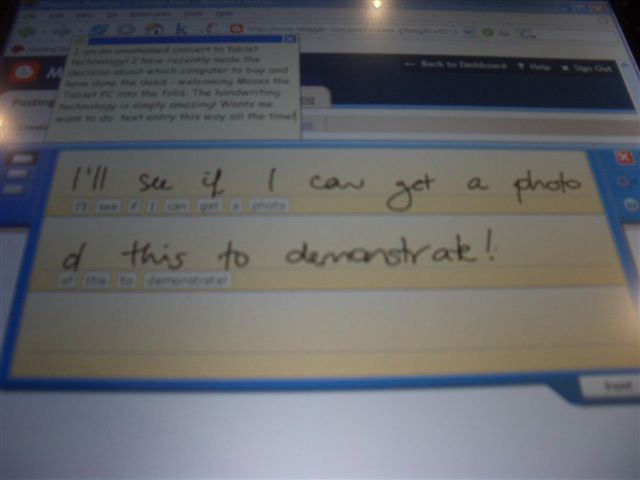 I am an unashamed convert to tablet technology! I have recently made the decision about which computer to buy and have done the deed - welcoming Moses the Fujitsu Lifebook T4010 Tablet PC into the fold. The handwriting technology is simply amazing! Wants me want to do text entry this way all the time! I'll see if I can get a photo of this to demonstrate! And I haven't ever tried the voice recognition software yet. Undoubtedly, there will be more to follow!
Ban all butts
David Mansford of Canterbury (NSW?) has sent in this letter to The Daily Telegraph:
The answer to our worst litter problem is simple: ban cigarette butts. Then the only litter that smokers leave behind would be a bit of papeer and a bit of tobacco (not a synthetic filter that lasts for decades). What possible objections would the smokers have? The risks to their health?And speaking of rubbish - what do you do when you see someone drop rubbish on the street - right next to a garbage bin? Is there a proper etiquette for getting them to pick it up and bin it ... "Hey Tosser"?
Teacher-student relations
High school teacher Robert Drummond has been sacked after a year-long investigation into his relationship with a student. The relationship because public after the student, Melanie Docwra, sat her HSC exams at the end of 2004.
Why does it take so long to investigate these and similar allegations? Does it take longer if the student/teacher are both willing participants? What if Melanie had accused Mr Drummond of unwanted sexual advances? Would this have taken a year to investigate? Or would this have become a police matter?
Why does it take so long to investigate these and similar allegations? Does it take longer if the student/teacher are both willing participants? What if Melanie had accused Mr Drummond of unwanted sexual advances? Would this have taken a year to investigate? Or would this have become a police matter?
Fact or fiction
July 2005. Rural Turkey. Five members of the same family are found to suffer from a recessive gene disorder which has caused brain damage affecting balance and movement. Result: they walk on all fours - using their palms like heels, with their fingers angled up from the ground (as opposed to the knuckle walking more often associated with chimps and gorillas). Their 14 siblings are not affected by the disorder. The family are treated as outcasts by many villagers - but that may change after the BBC documentary about them screens next week.
Subscribe to:
Posts (Atom)